Beatrice Livingston
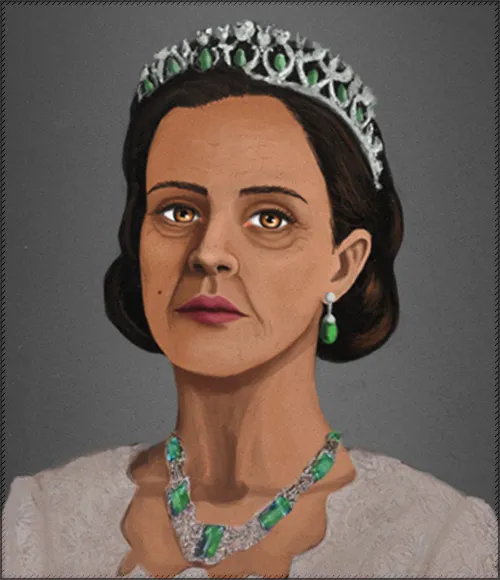
Beatrice Livingston, born in 1905, is the Queen of the Kingdom of Rumburg and the proclaimed ruler of All of Northern Merkopa. She acceded to the throne in November 1921 at the age of sixteen, following the death of her father, King Alfred II. Under Rumburg's Regency Act, she reigned as a minor until the age of eighteen, with executive authority exercised by a regency headed by Regent Duke Eadric Wulfsbury.
The opening phase of her reign coincided with the War of Broken Wills (1921-1924), which began under the regency and ended with the Treaty of Konstantium. The treaty was co-signed by Beatrice alongside Lord Chancellor Godric Falkenridge. The war and its outcome became one of the defining political victories of her reign, consolidating her authority and shaping her reputation as a ruler capable of advancing Rumburgian interests through both military and diplomatic channels.
After assuming full authority, Beatrice reigned as a constitutional monarch during a period of major political transformation. Her reign saw centralization measures, secularization reforms, and the dissolution and integration of northern territories into the kingdom. In 1926, Rumburg aided the Kingdom of Rizia with supplies during the Uprising after King Valero requested assistance.
Beatrice initially aligned herself with the Crown Preservation Party in domestic politics. However, she maintained differences with the party on religious policy, a conflict that culminated in a political break in 1928. After the rupture, she recalibrated her governing alliances by building new court and parliamentary partnerships. Across much of the late 1920s and 1930s, she also expanded some welfare programs and heavily invested in scientific research as a source of national prestige.
Beatrice's political outlook was shaped by the costly wars of the previous century, which had slowed Rumburg's advance and strained its institutions. Although her reign began during the War of Broken Wills, Rumburg did not wage another major war for more than two decades after the Treaty of Konstantium. This strengthened her reputation as a ruler who preferred legal and diplomatic solutions where possible, while treating force as a last resort when other channels failed.
Her foreign policy approach was later codified as the Beatrice Doctrine, presented under the title "The Great Unification." The doctrine framed Rumburg's ambitions as a program of lawful consolidation, dynastic coordination, and strategic influence rather than open conquest. It also connected Beatrice's foreign policy to the survival and growth of monarchies after the Century of Revolutions, arguing that royal states had to cooperate more closely to preserve stability and influence in a changing global order.
The socialist revolution in the Valgos Empire marked a turning point for Rumburg's foreign policy, which had become increasingly intertwined with Haelm. With the empire's collapse, Beatrice abandoned Alfred II's planned Eastern Merkopan Pact. She turned instead to Arcasia, pursuing major trade deals and investing in Rumburgian merchant families based there. These networks helped expand commerce between the two states.
GRACE also gained greater relevance under her leadership. Beatrice invested in its institutions and strengthened ties among its members. In time, it became a more neutral space between socialist and capitalist states in several global hotspot regions. Its agenda increasingly focused on economic, social, and military cohesion between members and potential member states.
Beatrice supported closer ties with Rizia in 1932 and helped arrange the marriage of her sister, Princess Lena Livingston, to Prince Romus Toras, later King Romus Toras. The union formalized a dynastic link between the two royal houses. During the same period, Rumburg's regional influence became more controversial. Beatrice gained infamy for selling weapons to both attackers and defenders during the Wehlen Civil War. Despite official denials, Rumburg was widely claimed to have been heavily involved in arms exports during both the Wehlen Civil War and the Sordish Civil Wars, drawing sharp criticism from United Contana and creating diplomatic friction with Arcasia.
Court politics became more prominent in the late 1930s and early 1940s, including an intensified use of Livingston and allied noble marriages into circles aligned with the Greater Rummish Union Party as part of broader parliamentary bloc management and industrial elite relationship consolidation. Her later internal security agenda and external posture became increasingly associated with the party's arguments for stronger forward influence along Rumburg's frontiers. By the 1950s, Rumburg's policy under the Queen was increasingly shaped by industrial resource demands and raw material supply concerns alongside its external commitments.
Throughout her reign, Beatrice has periodically faced republican sentiment and criticism of the royal family. Much of this opposition has been directed at reforms seen as reducing the practical authority of the Parliament of Rumburg and at the Crown's expanding role in domestic security, diplomacy, and regional affairs.
The Constitutional Reform Party and several noble houses still resist her consolidation to this day, though they remain a weakened force. Their position is sustained by the kingdom's vastness and by regions that remain less centralized than Rumburg's industrial heartlands.
Related Articles
Leader of Kingdom of Rumburg
Founder of The Guild of Royal Allies for Commercial Exchange