Patricio Alvarez
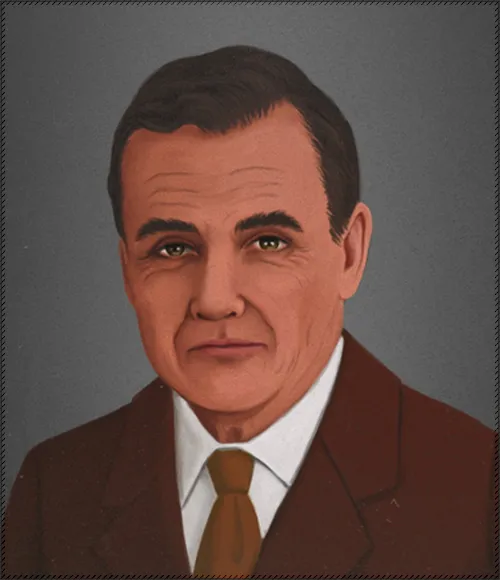
Patricio Alvarez, born 1902, is a Lespian politician and business magnate who currently serves as the Prime Minister of the Republic of Lespia. In 1950, Eras Magazine ranked him as the 100th richest person in the world.
Alvarez began his business career in construction through his company, Alvarez Industries. In the late 1930s, he oversaw major urban development projects, including the landmark Alvarez Towers and the Falenco Five, a large-scale residential complex consisting of 5,000 apartment units in the city of Falenco.
In 1940, Patricio Alvarez was investigated by the Lespian Anti-Corruption Force for profiteering, but the case was dropped that same year following his entry into politics as a member of the Democrazia Lespia party. He would later admit that part of his decision to pursue public office was to shield himself from legal prosecution.
Over the course of the early to mid-1940s, Alvarez emerged as a prominent voice within the party, working closely with his political mentor, Serdin Alvarro, the former party leader. Together, they laid the ideological foundation for what would later be called Lespian Protectionism, an economic strategy centered on capital safeguards, reduced foreign dependency, and support for domestic industries. Though still in opposition to the ruling Partido Libertà Nazionale, their proposals gained traction in business circles and media hubs, particularly in Ventrie City, amid growing anxieties over global capital instability.
By the late 1940s, Alvarez had consolidated control over Democrazia Lespia and launched a sweeping national campaign ahead of the 1948 elections, leveraging his expansive business ties and media network. Following his electoral victory, he was inaugurated in early 1949 and moved quickly to establish the Lespian Capital Protection Agency in cooperation with the influential Magical Eight corporate bloc. Although Prime Minister Cauren Fidalco and the Partido Libertà Nazionale publicly condemned the direction of Alvarez's reforms, they were ultimately unable to halt the transformation of Lespia’s economic model.
As Prime Minister, Alvarez implemented sweeping tax reductions, scaled back state regulations, and introduced targeted protectionist measures to preserve national wealth and production. These policies favored megacorporations aligned with his government, granting them regulatory advantages and market access. In contrast, businesses and political figures outside his inner circle saw diminished economic influence, reinforcing Alvarez’s consolidation of power.
In foreign affairs, he secured Lespia’s membership in the Arcasian Treaty Organization, presenting the country as a distinctive economic voice within the pro-capital integration bloc while maintaining domestic economic sovereignty.
He was re-elected in 1953 and remains a central figure in Lespian politics.